
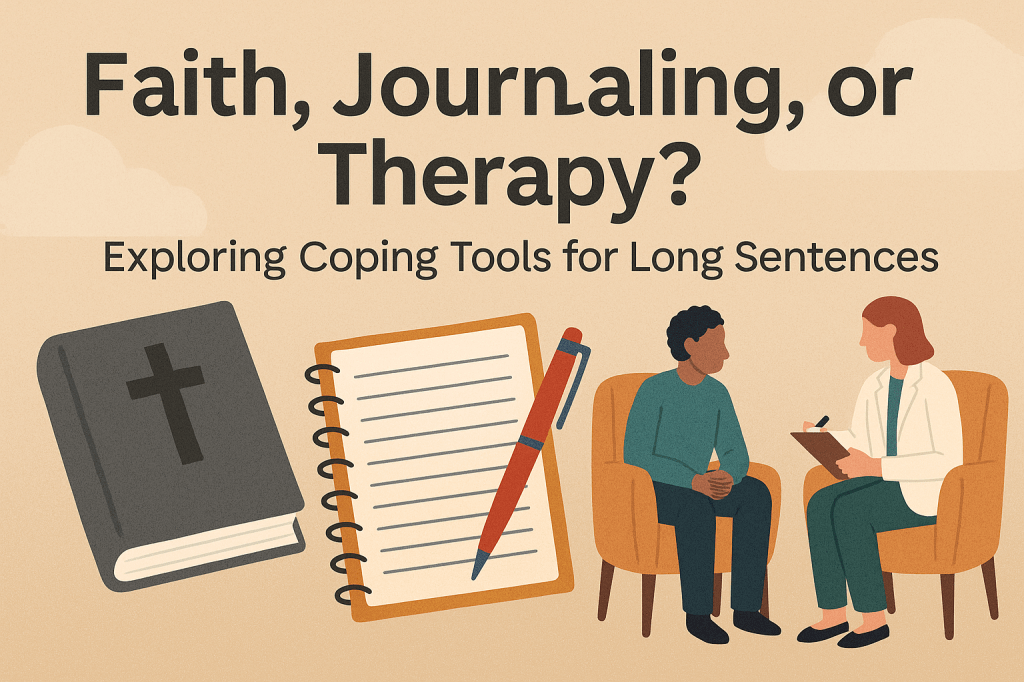
Exploring Coping Tools for Long Sentences and How to Support Your Loved One’s Healing
Long sentences come with more than just time—they come with grief, emotional fatigue, anger, and the slow, daily weight of endurance. If you love someone serving a long sentence, you’ve probably asked yourself: How can I help them cope when I can’t be there every day?
While there’s no one-size-fits-all answer, there are tools that can help. Coping isn’t just about surviving—it’s about creating small spaces for peace, growth, and mental strength.
Let’s break down some common coping tools—and how you can gently guide your loved one toward the ones that actually help.
✍️ Journaling: A Private Space to Process and Heal
Journaling is one of the most accessible, effective tools inside prison walls. With a notebook and a pen, your loved one can:
- Reflect on their thoughts without judgment
- Process emotions in a safe, private way
- Set goals, record dreams, and track progress
- Practice gratitude and build self-awareness
You can encourage journaling by:
- Sending prompts with your letters (e.g., “What does strength mean to you right now?” or “What’s one thing you’re proud of this week?”)
- Mailing blank notebooks or lined paper (check what’s allowed at the unit)
- Sharing your own journal entries as examples
- Reassuring them that it’s okay to write without needing it to be shared or perfect
Journaling is often the first step toward emotional healing because it gives people a way to hear themselves clearly.
🧠 Therapy: Real Support for Real Emotions
Therapy inside prison can be inconsistent or hard to access, but that doesn’t mean mental health support should be ignored. If your loved one is eligible for programs, group therapy, or has access to a counselor, encourage them to take that step—even if it’s just to try.
Therapy helps with:
- Managing depression, anxiety, or trauma
- Learning how to communicate emotions
- Developing better coping skills for day-to-day stress
- Rebuilding self-worth after years of punishment
If therapy options are limited:
- Suggest writing “pretend” letters to a therapist as a form of self-guided talk therapy
- Send resources about emotional regulation or cognitive behavioral tools
- Ask if mental health classes or groups are available at their unit
- Encourage small conversations about emotional health in your letters or phone calls
🙏 Faith: A Path Some Choose, But Not Required
Some people find comfort in religious practices or spiritual reflection. That can be valid and grounding for them. But for others, faith may feel disconnected, triggering, or not relevant to their healing.
Instead of pushing faith as a universal solution, meet your loved one where they are. If they draw strength from spiritual belief, support it without pressure. If not, help them find secular ways to explore meaning, hope, and peace—through writing, therapy, nature (even if it’s just looking at the sky), or meditation.
How to Start the Conversation
You might say:
- “Have you ever thought about writing things down, just for yourself?”
- “What’s been helping you cope with the long days lately?”
- “If there was one thing you could talk through with someone, what would it be?”
- “I read that journaling can help sort out feelings—if you want, I can send some prompts.”
- “You deserve to feel heard, even if it’s just on paper.”
The goal isn’t to fix everything. It’s to offer tools—and remind them that healing is still possible, even inside four walls.
A Tool to Help You Stay Connected
If you want to keep the emotional connection strong while helping your partner explore their own growth, check out our Couples Communication Guidebook. It includes journal prompts, letter templates, and reflection exercises you can use together—no religious framing, just real, grounded connection.
💬 Healing takes time. But it doesn’t have to happen alone.



 Chapters and Chains
Leave a comment