
Romantic relationships where one partner is behind bars are often misunderstood. These relationships face unique challenges, and outsiders frequently assume the worst. In reality, many couples separated by prison walls find ways to stay connected and support each other. This post will debunk five key myths about romantic partnerships during incarceration, using research and statistics to set the record straight. The goal is to replace stigma and misconception with understanding and facts. Feel free to share.





Myth 1: “No Relationship Can Survive Incarceration.”
Reality: Incarceration certainly puts strain on a marriage or partnership, but it does not make it impossible to stay together. While studies show that imprisonment is linked to higher divorce rates, it’s not a death sentence for every relationship. In fact, a significant number of incarcerated people remain committed to their partners. Over a quarter of federal prisoners (26%) and about 16% of state prisoners are legally married, and many more have an intimate partner despite being incarcerated. This data shows that tens of thousands of couples choose to continue their relationships through a prison term.
Of course, maintaining a relationship through years of separation isn’t easy. The longer the prison term, the more pressure on the relationship – one study found each additional year behind bars raised the odds of divorce by roughly 32%. But “more likely to divorce” does not mean inevitable. Couples who communicate honestly, build trust, and plan for the future can and do survive this ordeal. Some even report that coping with limited contact (like exchanging letters) brings them closer in emotional ways. Rather than an abrupt ending, many prison relationships become a test of commitment. Those that endure emerge stronger and deeply bonded by the experience.
Myth 2: “Only Desperate or ‘Crazy’ People Stay with an Inmate.”
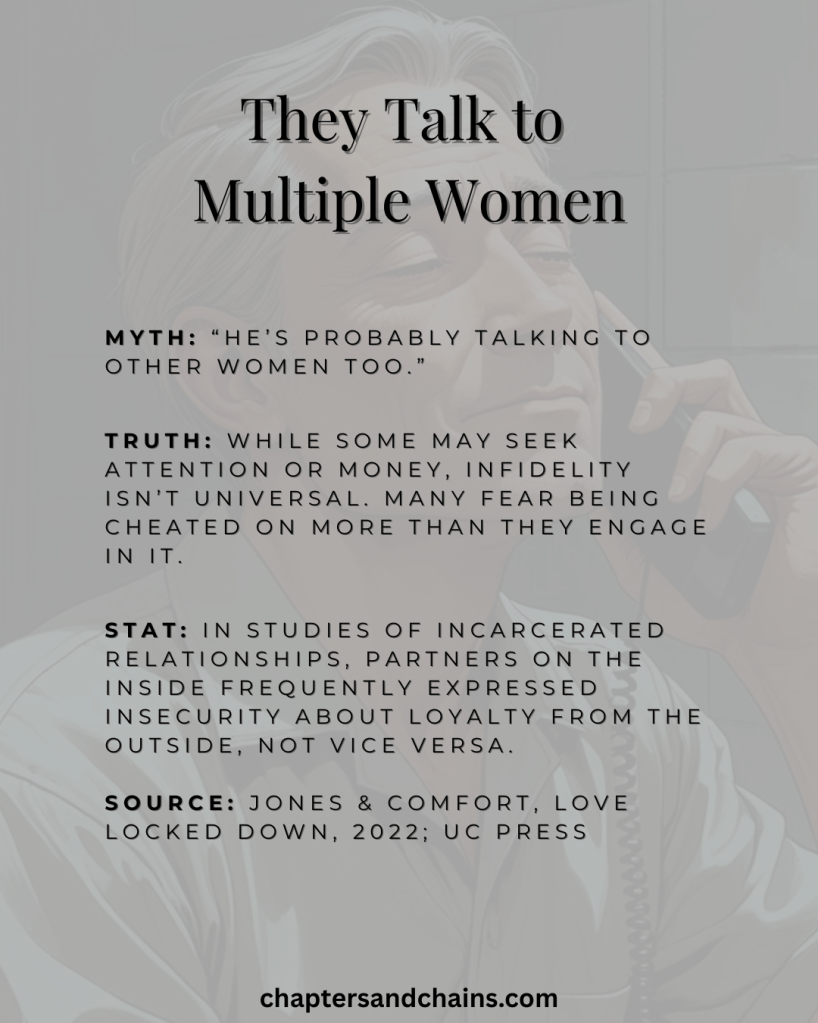
Reality: This cruel stereotype unfairly labels the devoted partners of incarcerated people. In truth, spouses and significant others who stand by an inmate come from all backgrounds and are often motivated by loyalty and love, not dysfunction. Researchers have documented the “courtesy stigma” that society casts on these partners – friends or family may assume there is something wrong with them for dating someone in prison. One study interviewed women with incarcerated husbands or boyfriends and found that nearly all had faced judgment or ridicule from people around them. They were accused of having poor judgment or even poor mental health for staying in the relationship.
What outsiders miss is the resilience and agency these individuals show. The same study noted that the women actively pushed back against the stigma, embracing their decision to stay and even highlighting unexpected positives in their relationships. For example, because they couldn’t rely on casual daily contact, couples learned to communicate through thoughtful letters and calls – which some partners found more meaningful and intimate. Far from being “delusional,” many partners of prisoners are clear-eyed about the challenges. They make conscious choices to maintain the relationship, often after weighing the costs and benefits. Rather than desperation, their commitment can reflect strength, hope, and love in the face of hardship. It’s a reminder that caring for an incarcerated loved one is not a flaw or folly – it’s an act of courage that deserves respect, not scorn.
Myth 3: “Prison Relationships Aren’t Real – The Inmate Is Just Using You.”
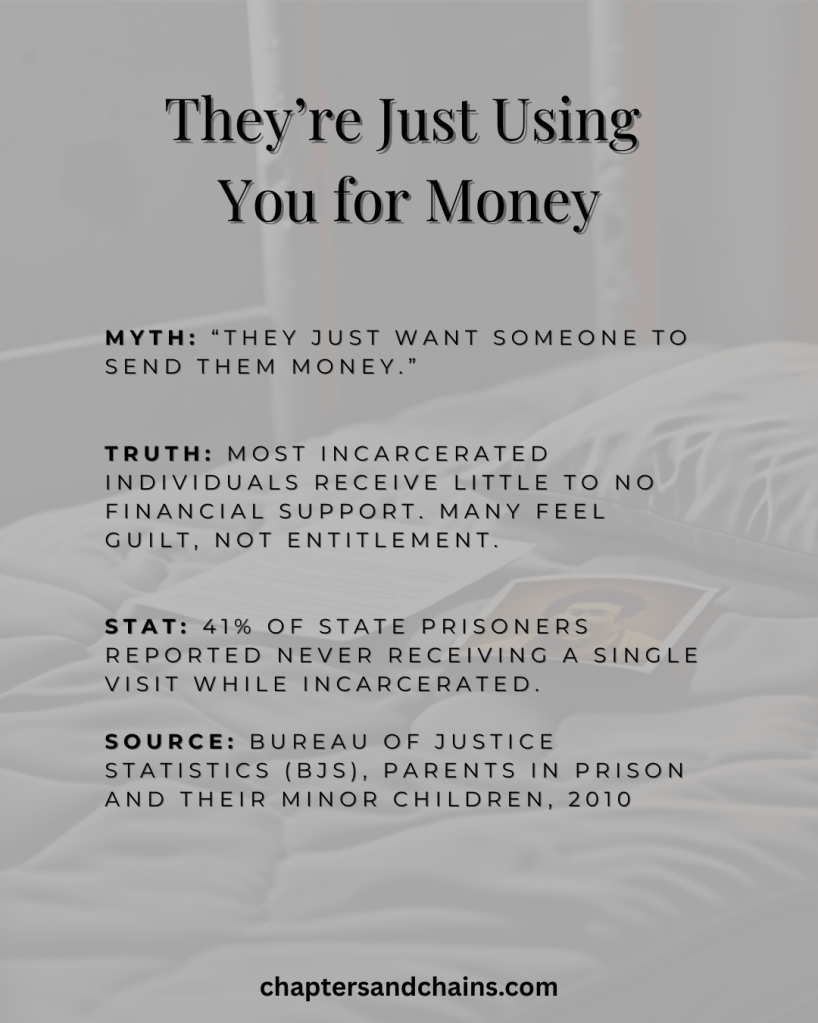
Reality: The trope of the manipulative inmate conning an outsider for money or favors is overgeneralized. Yes, there are cases of financial scams and insincere prison pen-pals, but it is not true that all romances behind bars are a sham. In fact, many incarcerated individuals deeply value their partners and crave genuine emotional connection. A commentary on prison letter-writing notes that while “there are some genuine and sincere relationships” alongside the scams, “these people will not always con you”. In other words, plenty of people in prison seek love and support in earnest, not merely as a hustle. They may have nobody else in their corner and turn to romantic correspondence for a sense of belonging and care.
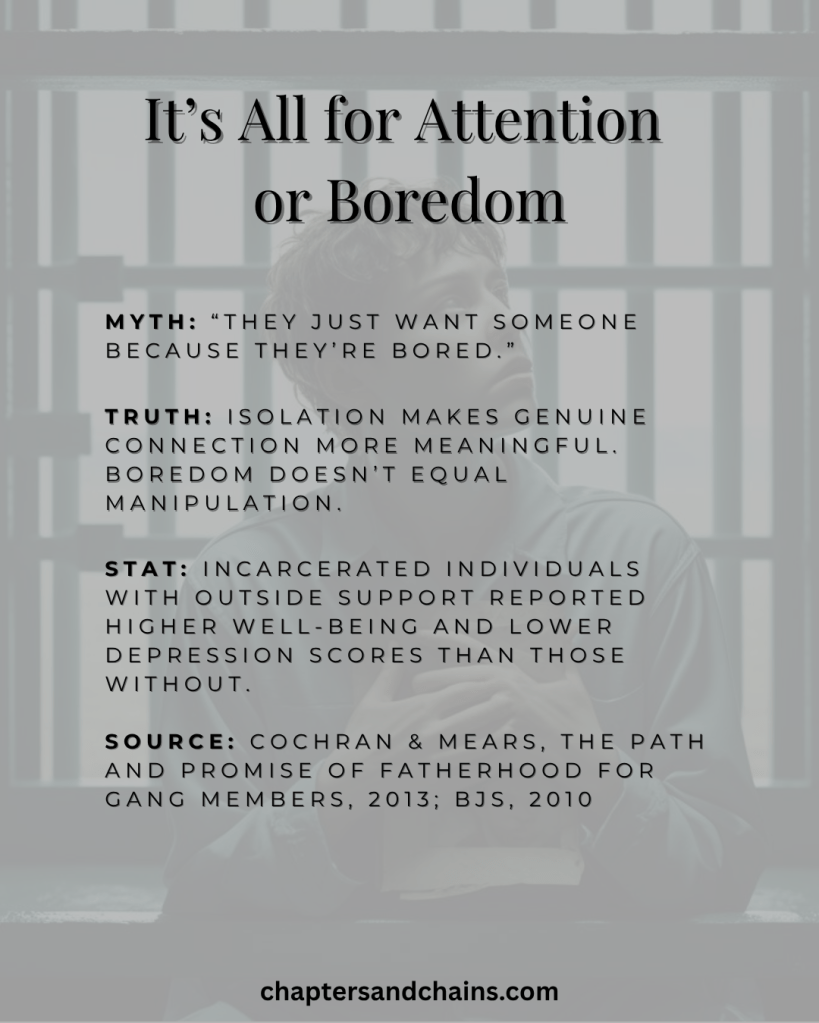
The authenticity of prison relationships is evident in the efforts couples make to keep their bond alive. Inmates often devote time to writing long letters, expressing vulnerability and emotion. Partners on the outside sacrifice time and money for visits and phone calls. These are not the actions of people who think the relationship is fake. Moreover, the benefits flow both ways. Many incarcerated men and women credit their partner’s encouragement with helping them survive the isolation of prison and motivating them to improve themselves. Likewise, partners outside often feel their incarcerated loved one supports them emotionally – listening to their struggles and offering love from afar. Dismissing all prison relationships as “not real” overlooks the very real commitment and care involved. While caution is wise (for example, experts warn that if an inmate immediately asks a pen-pal for money, that’s a red flag), painting every incarcerated person as a con artist is a myth that ignores the genuine love stories that do exist behind bars.
Myth 4: “Couples Can Just Rely on Conjugal Visits and Phone Calls – It’s Easy to Stay in Touch.”
Reality: Communication for prison couples is anything but easy. Pop culture gives the false impression that inmates get regular conjugal visits (private visits for intimacy) or have ample free time to call and write. The truth is that opportunities for contact are severely limited. Conjugal visits, in particular, are extremely rare – only four U.S. states currently allow them at all. (At one time in the 1990s, as many as 17 states had such programs, but almost all have since been eliminated.) In the vast majority of prisons, couples never get to be alone together. Even a simple hug or kiss is usually restricted to a brief greeting and farewell in the visiting room under guard supervision.
Regular visitation itself is often infrequent. Prisons are typically far from home (over 100 miles away on average for state prisoners), making travel costly and time-consuming. As a result, fewer than one-third of people in state prisons receive even one visit per month from any loved one. Phone calls and emails are available in most facilities, but they come with high price tags and strict rules. A short 15-minute phone call can cost families exorbitant fees, and many prisons limit call times or cut off communication as punishment. Mail is often delayed or censored, and all correspondence lacks the comfort of in-person presence.
In short, couples separated by incarceration face forced long-distance relationships under the hardest conditions. They must nurture love through letters that take days or weeks to arrive, hurried phone calls, and, if they’re lucky, occasional face-to-face visits across a prison visiting table. Far from being “easy,” staying in touch requires patience, determination, and creative effort from both partners. This reality debunks the myth that prison provides plenty of time for romance – in truth, every exchanged word is hard-won.
Myth 5: “Supporting a Partner in Prison Serves No Purpose – It’s Better to Move On.”
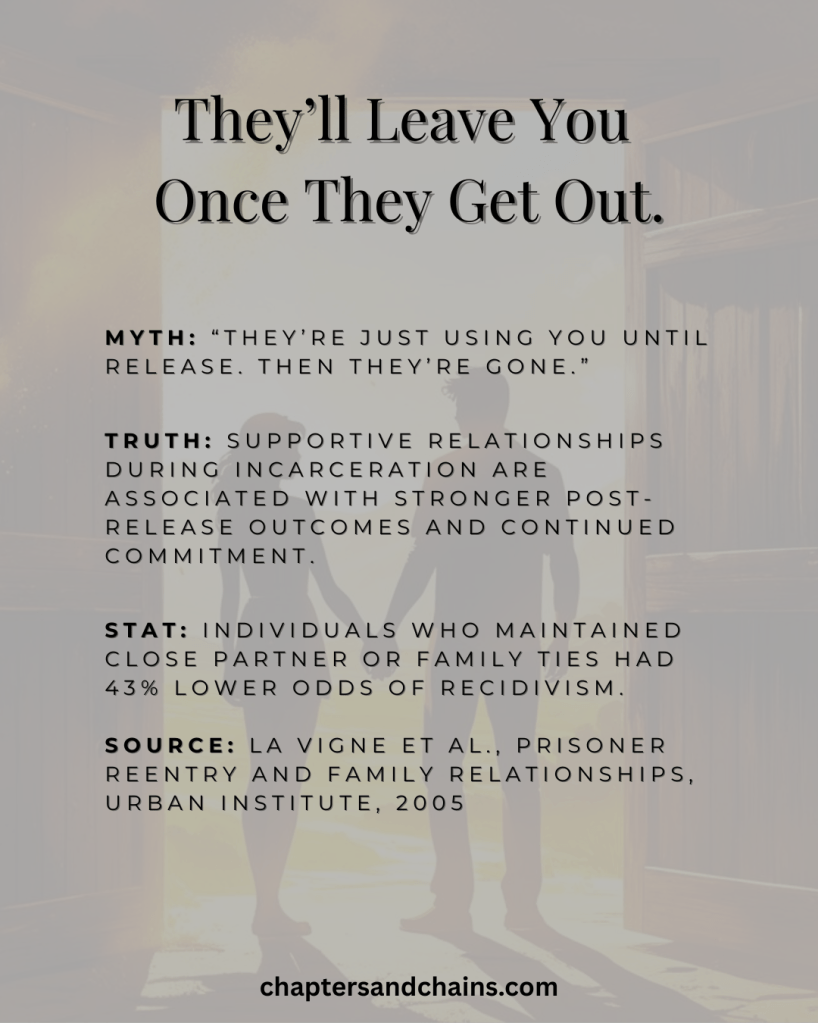
Reality: This myth is not only false, it’s harmful. Research consistently shows that maintaining healthy family and partner ties during incarceration has real benefits – for the individual, for the relationship, and for society. Studies spanning decades have found that incarcerated people with close family connections have lower recidivism rates(meaning they are less likely to reoffend) and better post-release outcomes. Contact with a loving spouse or significant other can improve an inmate’s behavior and mental health while inside, and it helps them transition back into the community more successfully. One analysis of parole outcomes revealed that people who received no visits were six times more likely to end up back in prison than those who had frequent visitors. Clearly, the support of loved ones is a powerful stabilizing force.
From the perspective of the outside partner, staying in the relationship can also be rewarding. Many spouses find purpose in providing emotional support, and they experience personal growth by overcoming adversity together. It is important to note that a strong, prosocial relationship can steer an incarcerated person away from trouble: criminologists observe that committed partners “help steer activities away from potentially offending again” and raise the stakes of re-offending. In other words, having someone to reunite with gives inmates a positive incentive to rebuild their lives. Society benefits too when released individuals have a solid support system – it means a smoother reentry and a lesser chance of future crime.
None of this is to say that continuing a prison relationship is the right choice for everyone. Each situation is unique, and the outside partner’s well-being matters enormously. But the blanket assumption that “it’s not worth it” is wrong. When a relationship is healthy and built on mutual respect, it can absolutely be worth it – and even life-changing – to stand by an incarcerated loved one. Far from being pointless, such loyalty can be a lifeline that helps the incarcerated person become a better spouse, parent, and citizen upon release.
Conclusion
The public misconceptions about prison relationships often underestimate both the difficulties and the strength of the couples involved. Yes, loving someone through the bars of a cell is challenging. There are heartbreaks, days of loneliness, and social disapproval to contend with. But as we’ve seen, these relationships are not defined solely by tragedy or futility. They are real relationships – complex and meaningful – that can endure despite the odds. By debunking these myths with data and real experiences, we find a more empowering truth: strong, healthy love is possible even in the harsh environment of incarceration. Such relationships, when nurtured with honesty and care, are worthy of support and understanding. Rather than write them off, society should recognize that love and commitment can thrive in the unlikeliest places – and that everyone benefits when those bonds are allowed to grow.
Sources: Prison Policy Initiative; Bureau of Justice Statistics; University research studies; Healthy Marriage & Family formation reports criminology.fsu.edu defensenet.org news.utdallas.edu news.utdallas.edu re-engineeredyou.com scalawagmagazine.org prisonpolicy.org defensenet.org news.utdallas.edu.



 Chapters and Chains
Leave a comment