-
Continue reading →: Why Long-Distance Prison Relationships Fail—and How Some Don’t
Prison relationships face unique challenges that test their endurance. Distance, cost, and restricted communication create barriers that strain bonds over time. Research highlights that maintaining family contact during incarceration leads to better outcomes after release. However, the system’s limitations make sustaining these connections difficult.
-
Continue reading →: Tax Season for Prison Families: What to Know
Tax season can feel confusing in any year. It gets more complicated when your spouse is incarcerated, you are carrying most of the bills alone, and you are trying to figure out what still applies. A lot of prison families end up asking the same questions. Can I still file…
-
Continue reading →: When Advocacy Becomes Necessary
Most issues inside a prison do not resolve on their own. They also do not improve just because you stay quiet. Advocacy becomes necessary when a problem is affecting health, safety, due process, or release planning and the normal channels are not working fast enough. You do not need legal…
-
 Continue reading →: How Prison Changes Time in a Relationship
Incarceration significantly alters the perception of time within relationships. While the outside partner experiences regular life changes, the incarcerated partner endures repetitive routines. This contrast creates emotional tension and the need for communication. Couples must acknowledge their divergent timelines, adapt their shared experiences, and understand that growth occurs differently for…
-
Continue reading →: What People Don’t Tell You About Prison Phone Calls
Staying connected to someone in prison often involves more than just phone calls. These calls are a lifeline, but they come with unique rules and emotional weight that outsiders rarely understand.
-
Continue reading →: The Invisible Labor of Prison Partners
When someone goes to prison, the sentence rarely belongs to just one person. Partners often become the quiet infrastructure holding everything together. The outside world usually sees prison relationships in simple terms. Someone visits. Someone writes letters. Someone answers the phone when it rings. What people do not see is…
-
Continue reading →: What Reentry Conversations Should Start Years Before Release
When your partner is in prison, it’s easy to tell yourselves, “We’ll figure it out when they get out.” In reality, reentry is too important to leave until the last minute. Planning years in advance can make the difference between a smooth homecoming and a heartbreaking return to old cycles. This guide lays…
-
Continue reading →: February Closes, But the Weight Lingers
February carries a strange kind of weight for those loving someone inside. It’s short on days but long on feelings. Love is everywhere, but rarely in the form we’re allowed to hold. We mark time through stolen phone calls, delayed letters, and vending machine visits instead of dinner reservations. Some…
-
 Continue reading →: Locked Up Love: Why Prison Relationships Struggle and How Some Survive
Maintaining a romantic relationship through the walls of a prison is an immense challenge. When one partner is incarcerated and the other is on the outside, the relationship must withstand years of separation, stress, and uncertainty. Research and lived experiences show that these long-distance prison relationships often fail – not…
-
 Continue reading →: How to Measure Progress When Nothing Feels Like It’s Moving
Incarceration distorts time. Days repeat. Systems stall. Decisions delay. From the outside, it can feel like effort disappears into a void. Progress still happens. You just need different tools to see it. This post focuses on how to measure progress when outcomes stay frozen. It centers on small indicators, emotional…
Welcome!
This is Chapters and Chains

Welcome to Chapters and Chains – I created this site for those looking for a way to connect with a loved one who is incarcerated and who are navigating the complex correctional systems across the United States.
Find out more about us in this LWW Podcast .
Here you will find ways to connect through reading and books with your loved one, information on how to put parole packets together, resources for reintegration and helpful planning documents. All resources are and will always be free or low-cost.
However, if you would like to say “Thank you!” you can donate below or at $ChaptersNChains

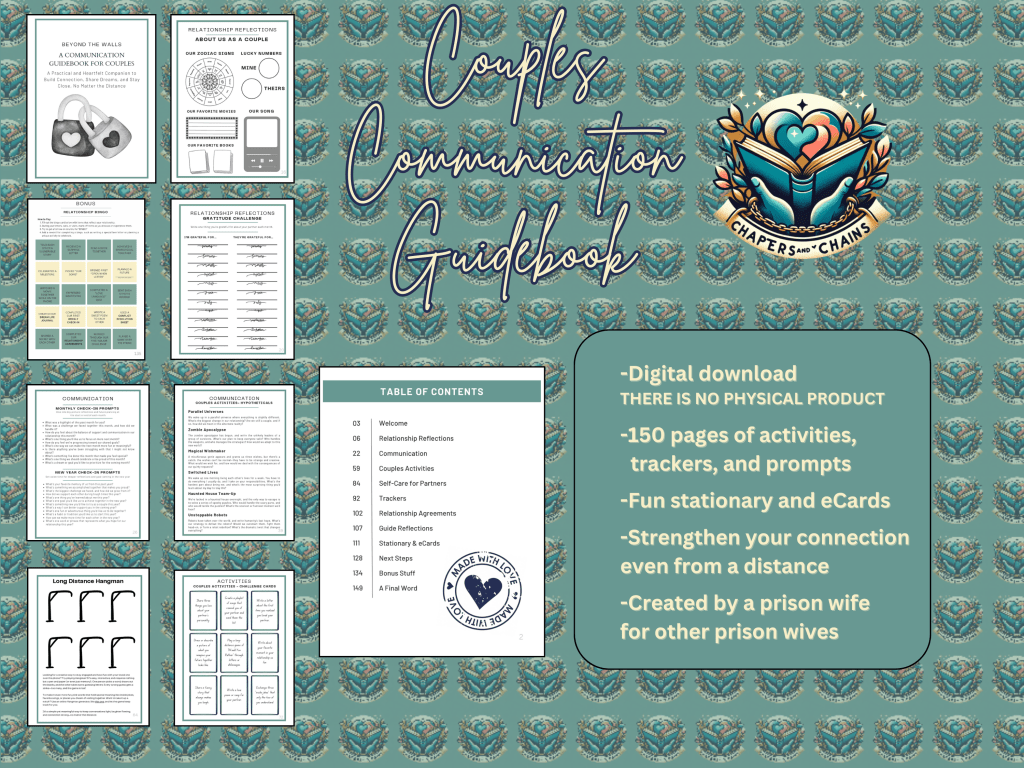
You can also purchase “Beyond the Walls: A Couples Communication Guidebook” that helps fund this site and the work that we do!